
ES-KMS · EngineerStory Knowledge Management System
We don't stop at storing documents.
We read them every day, organize them, and answer.
Engineer Story delivers IT consulting and system implementation in aviation, travel and logistics, and every project has left behind a large body of deliverables. Rather than settle for a search tool, our own team designed and built ES-KMS, an AI knowledge management system that reads this material every day, organizes it into knowledge, and answers using only what is cleared for publication.
One flow
Collection → indexing → knowledge cards → review → public answers, all carried through in one system.
AI organizes, people approve
AI reads the material and drafts the knowledge cards. People decide what is published and the final wording.
Knowledge that grows every day
New cards are written every night, and existing cards are revised every week to follow IT trends.
ES-KMS in numbers · as of Nov 2026
WHY IN-HOUSE
Turning scattered documents into a company knowledge asset
At an aviation, travel and logistics IT company, every project piles up deliverables, yet they are hard to find when they are actually needed.
Engineer Story did not stop at a search tool. Our own team, who know how we work better than anyone, built a system that reads the material every day, organizes it into knowledge, and answers using only what is cleared for publication.
Deliverables with different folders and formats on every project
Know-how that leaves when the person in charge changes
IT knowledge that changes fast and soon goes stale
Telling apart what can and cannot be made public
OVERVIEW
Product overview and two knowledge flows
ES-KMS (EngineerStory Knowledge Management System) is an AI knowledge management system that turns the company's documents into knowledge and releases that knowledge to the outside safely. A single document runs from indexing to a knowledge card, and a single card runs from review to an answer on the website, on the same rules.
Knowledge flow
Publication flow
FUNCTION MAP
Functions at a glance
| Area | Main functions |
|---|---|
| Collection | Designated Drive folders checked daily, with new, changed and deleted files reflected in the list |
| Classification · exclusion | Automatic classification of knowledge targets; personal data, résumés, encrypted (DRM) files and build outputs excluded by rule |
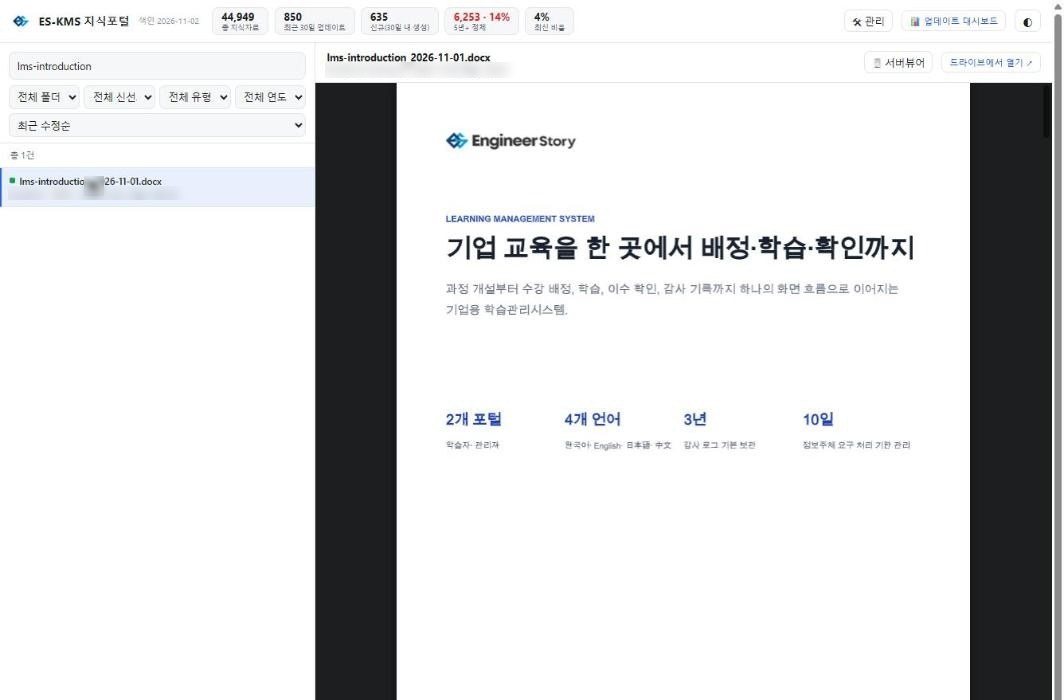
| Knowledge portal | File-name search, filters by folder, freshness, type and year, instant preview of documents, sheets and decks |
| Semantic search | A dedicated search server indexes documents by meaning, and finds related content when asked in a sentence |
| Freshness management | Material update dashboard, current and stagnant ratios per folder, candidates for review of old material |
| Access management | Read-only access for designated staff and collaborators only, collaborator expiry dates, access logs |
| Knowledge cards | Cards written by topic under a classification scheme, in two layers: internal text and public text |
| Review · approval | Decisions made in the review document's status column (approve, revise, reject), with history kept by edition (v1→v2) |
| Trend updates | Industry trends researched weekly and revisions proposed for related cards, with a freshness review cycle per card |
| Public edition | Only approved public text bundled into a weekly edition for the website, with a list of changed cards |
| Website answers | Field buttons and sentence questions, source knowledge cards shown, general explanation kept apart from company experience |
| Operations · security | Daily automatic checks and backups, index purge for deleted originals and personal-data erasure requests, server access audit logs |
AI KNOWLEDGE CARD
Knowledge cards written by AI, approved by people
Close reading
Every night, material is read in depth by folder and topic in a set order.
Card draft
A draft is written with classification, title, internal text, public text and sources.
Review · approval
Approve, revise or reject in the review document, and the decision is applied as is.
Master copy and editions
Approved cards become the master copy, and a revision raises the edition while keeping the previous one.
Example: after reading a bundle of project deliverables, the system writes a card such as «What to consider when an airline adopts an LMS». The internal text holds the details of the source material; the public text holds only a generalized explanation, without client names or amounts.
PUBLIC CHECK
Two-layer publication and automatic checks
Internal knowledge and public knowledge are split into two layers from the start. Only public text approved by people reaches the website, and only after passing two automatic checks.
Pre-publication checks (2 automatic layers + publication rules)
| Item | Handling | What is caught |
|---|---|---|
| Personal names · titles | Excluded | Surname + given name + title patterns |
| Amounts | Excluded | Figures with currency units |
| Clients · addresses | Generalized | Client names, web addresses |
| Sensitive topics | Internal layer | Merger details, business opportunities |
Result: if even one item is caught, the card is left out of the edition, fixed, and checked again.
How a public edition reaches the website
- Only approved public text is bundled, one line per card, into a weekly edition
- Each edition comes with lists of new, revised and removed cards and verification values
- Client names are generalized, and the internal layer is left out of the edition
- The website loads an edition only after running the same checks once more
DAILY PROCESS
A knowledge process that runs every day
Material check
Folder changes checked, file list updated
Indexing · exclusion
Knowledge targets indexed, sensitive files excluded
Card draft
AI drafts knowledge cards overnight
Review
People approve, revise or reject
Master copy
Approved cards made master, revisions raise the edition
Public edition
Weekly public edition created and checked
Website
Loaded to the website, answer quality checked
Steps 01 to 03 are handled by the system overnight, and people make the call at step 04. Approved knowledge becomes the basis for the next cards.
IT TREND UPDATE
Keeping up with changing IT trends
Finding trends
- Weekly, industry trends searched by field
- International bodies, governments and official technical documents first
- Company-approved material on the same topic comes first
Proposed revisions
- A «here is how this is changing now» paragraph added to related cards
- New cards only for new technology existing cards cannot cover
- Public text changes only after a person approves it
Freshness review
- A review cycle per card: fast 90 days · normal 180 days · slow 365 days
- Judged as no change · update needed · stale warning
- Once approved, the edition is raised and included in the next public edition
HOMEPAGE Q&A
Ask and get answers right on the website
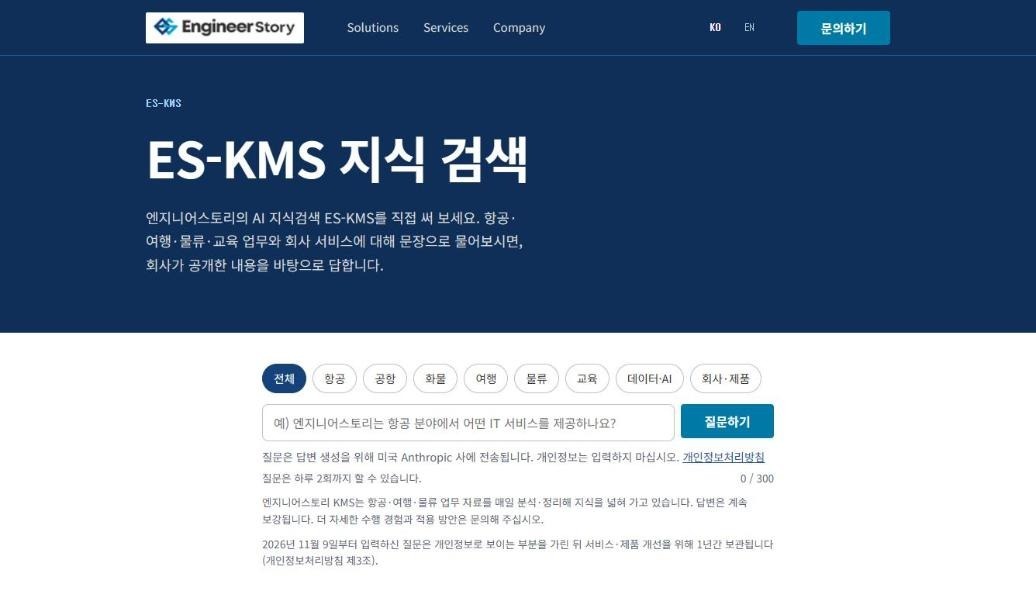
You can ask directly in ES-KMS Knowledge Search on this website.
Pick a field, ask in a sentence
Choose a field from Aviation, Airport, Cargo, Travel, Logistics, Education, Data & AI or Company & Products, and ask the way you normally would.
Source knowledge cards
Only knowledge cards the company has approved and published are used as the basis, and the source cards are shown under each answer.
General explanation apart from company experience
Overviews and key tasks are given as industry explanation, and Engineer Story's own project experience is shown separately.
Personal data protection notice
Users are asked not to enter personal data, the number of questions per day is limited, and anything that looks like personal data is masked before a question is kept.
SCREENS
Live screens
Actual screens of the website's knowledge search and of the internal knowledge portal for designated staff (Korean interface).


SECURITY
Security and access control
Permissions and access
- Google account sign-in, with access for designated staff and collaborators only
- All access is read-only, and collaborators must have an expiry date
- The search server's own screens are closed, with access only through the internal portal
- Viewing and administration are kept in access logs
Exclusion and records
- Personal data, résumés and encrypted (DRM) files excluded from knowledge targets by rule
- Material deleted at the source, and personal-data erasure requests, purged from the index as well
- Server access audit logs copied outside the server every day
- Sensitive topics used only as internal knowledge and left out of public editions
OPERATIONS
Automated operations and website sync
Every night, the system gets to work first
| Every night | AI knowledge card drafts and a result notice |
|---|---|
| Daily, before dawn | Audit log collection and material change check |
| Daily, before dawn | Knowledge data backup |
| Every morning | New knowledge reflected in the search server |
Each week it also prepares IT trend update candidates, and if all is well it only keeps a record.
Connected to the company website
- ES-KMS Knowledge Search on the website answers only from approved public knowledge cards
- A new public edition is created every week, and only changed cards are reflected on the website
PLATFORM
Built on tools we already have, growing as we use it
Google's work tools + a dedicated search server
- Google Workspace
- Source material storage, material checks and classification, internal portal
- Dedicated search server
- Semantic search index and knowledge storage
- Claude AI
- Knowledge card drafts, website answers
We are proving first-hand that a company can run knowledge management covering collection, search, knowledge cards and public answers with the work tools it already uses and a dedicated search server, without expensive commercial knowledge management software.
Approved master copies as of early November 2026, internal-layer cards included. New cards are added every night, and the public edition changes every week.
Next: website knowledge search in operation · wider links with learning management (LMS) and business management (BMS), wider use by staff
AI organizes. People approve.
Answers with sources
Approved knowledge cards, sources shown
Safe publication
Two layers, internal and public, with automatic checks
Knowledge kept fresh
Daily drafts, weekly trend updates
Efficiency
Finding goes to the system, judgment stays with people
WHY ENGINEERSTORY
Checkpoints for adopting a knowledge management system
Defining what can be public
Internal knowledge and knowledge for the outside must be split into two layers from the start before you can publish with confidence.
Excluding personal and sensitive material
Résumés, personal documents and encrypted files must be filtered out by rule before anyone has to pick them out.
Structured knowledge
Piling up files does not produce answers. Knowledge gets reused only when it is organized into cards that follow a classification scheme.
Human approval
Even for AI drafts, trust builds only when a person makes the final call before publication.
Freshness management
IT knowledge goes stale quickly. Each card needs a review cycle so changes are reflected.
Access logs and audits
Records of who viewed what, and separately kept server access logs, are what reviews rely on.
CONTACT
Talk to us about adoption
- Website
- www.engineerstory.kr
- Phone
- +82 10-7229-5786
- engineerstory2018@gmail.com
Engineer Story LC. · Sales lead Byoungjo Min
Rm 612, Mega Tower, 59-9 Magokjungang-ro, Gangseo-gu, Seoul, Republic of Korea